Pages

Tuesday, March 1, 2022

 The photos are in reverse order. Their place in the text after the pictures is indicated. 


AS 15 - A four-generation picture. Alvin Stehr, seated, with his son Wayne, (upper right), grandson Travis (upper left) and great-grandsons Owen (lower left), and Zayden (lower right). Courtesy of Wayne Stehr. 


AS 14 - During its decades of operation, Stehr Brothers Mill issued probably hundreds of different advertising items, and there are some large collections in the area that include even signs from the business.


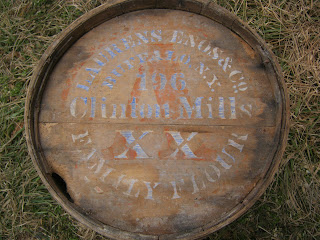
AS 13 - Inexpensive flour, transported in wooden barrels like this one from the Clinton Mill of Laurens Enos & Co. in Buffalo, New York, was locally sold in general stores throughout the region and gradually put area mills out of business. This barrel was found in the valley. Mahantongo Heritage Center. 


AS 12 - Huge grain elevators such as these in Buffalo, New York, supplied wheat to industrial-scale mills that, even when factoring in transportation, were able to undercut the price of locally-raised and processed flour in the Mahantongo area.

The Cargill Pool grain elevator in Buffalo, NY, as seen at sunset.”

Photograph by Yatpay, 2011.

https://commons.wikimedia.org/wiki/File:Cargill_Pool_Grain_Elevator,_Buffalo,_NY_2011.jpg

Public domain. Accessed 2/4/22. 


11. AS 11 - A common method of funneling grain into the grind stones. Gristmill hopper, Skyline Drive, Virginia, 1938. While this photograph is unattributed, it is assumed to be a HABS photo from the Library of Congress. Public Domain.

https://en.wikipedia.org/wiki/Gristmill#/media/File:Gristmill_Hopper_1938.gif. Accessed 2/7/2022


AS 10 - Clarence, the crazy cat, rescued at the former Stehr Brothers Mill, circa 1994, being consoled by Bro. Christian.


AS 9 - A "slipper" for feeding corn into the grindstones, at George Washington's Gristmill, Mt. Vernon, Virginia. Photographed September 23, 2007. by Kadin2048. Public domain.

https://upload.wikimedia.org/wikipedia/commons/4/48/Mt_Vernon_Gristmill_Slipper.jpg

Accessed 2/3/22.


AS 8 - Mahantongo grist mills also custom-milled flour and feed for other mills outside the valley, as these bags, made for businesses in Shamokin and

Sunbury but found in a local mill, indicate.


AS 7 - A diagram of a hammer mill shows how the machine works.

https://www.saintytec.com/working-principle-hammer-mills/

Accessed 2/8/22. 


AS 6 - Exterior of a typical hammer mill, which was the last type of grinder used at the Stehr mill. Steel hammers attached to a rotating cylinder pulverize grain into particles for making feed. Fasoli hammer mill. https://www.industrialdiscount.com/lots/fasoli-hammer-mill-and-flour-conveyor-system-42923/. Accessed 2/4/22


AS 5 - Rolling mills such as this one supplanted grinding stones. Grains were ground between rotating steel cylinders to make both flour and feed. Rolling Mill, Fisher-Fallgatter Mill, Waupaca, Waupaca County, WI. Photograph by Lowe and Jet for the Historic American Engineering Record (HAER). 1968. Library of Congress. <www.loc.gov/item/wi0005/>. Public domain. Accessed 2-8-2022.


AS 4 - The miller's house, to the left, was possibly built by the first miller, Daniel Herb, before Samuel Knorr bought the mill in the mid-nineteenth century. The grist mill is in the center, where Alvin worked; with the store and warehouse to the right, which was overseen by Chester.


AS 3 - The former Stehr Brothers grist mill today. The first story was brick on top of a stone foundation, with a timber-frame structure above that. This was where Alvin spent most of his time.


AS 2 - The mill's nineteenth-century under-shot water wheel may have looked similar to this water wheel from the Thomas grist mill in Chester County. Thomas Mill, Crum Creek (Willistown Township), Whitehorse vicinity, Chester County. 1933 photograph. Source: HABS (Historic American Buildings Survey), PA,15-WHIHO.V,2-8. Library of Congress. Public Domain, https://commons.wikimedia.org/w/index.php?curid=47678390


AS 1 - The Daniel Herb grist mill and miller's house, as they looked circa 1900 when owned by Samuel Knorr. Courtesy of Joan and Steve Troutman.


Alvin Stehr - The Last Miller of the Mahantongo


by Johannes Zinzendorf


Alvin Stehr, of Hepler, is now in his nineties. He is also the last miller of the Mahantongo Valley. At one time, practically every community in the valley had a grist mill to grind the grain raised by local farmers into flour and other products.

These were water-powered mills, so they were located adjacent to streams and creeks. Typically, a dam was built to back up the water and to provide a steady power source, with water diverted to the mill through a channel called the mill race. Large wooden wheels, often ten feet or more in diameter, were turned by the water; in our area the wheels were usually undershot, meaning the water struck the lower section of the wheel. I do not know of an overshot wheel in the area, where the mill pond was located up a slope behind the mill and the mill race was an elevated wooden trough that aimed the water at the upper part of the wheel. Overshot wheels are more prevalent in New England, typically located at a falls on a river or creek with the mill located below the falls.

In any case, only two mill buildings still exist in the valley of which I am aware; the Old Red Mill of the Gahres family on Creek Road just east of Route 125 [and owned by Marjorie Gahres Boyer], and the Stehr Brothers mill along the Little Mahantongo Creek at the line between Schuylkill and Northumberland creeks.

There is a Gahres connection between the two mills because Joseph Irvin Stehr, who later bought the Knorr mill, married into the Gahres family with his wife, Sallie, and his father-in-law taught him the milling craft of turning grain into flour and feed before he bought his own mill.

The go-to source for local grist mills is the landmark reference book The Penns' Manor of Spread Eagle and the Grist Mills of the Upper Mahantongo Valley by Steve E. Troutman (Third Edition published 2016 by Sunbury Press, Inc.).

According to Troutman, the mill at that site was originally built in 1808 by Daniel Herb.

Photograph AS 1A

The original mill stones were probably locally made from a very hard stone that Troutman [who studied geology in college and has also written Geology of the Mahanoy, Mahantongo, and Lykens Valleys: Something about the Earth We Walk On, Sunbury Press, 2014] says is called “conglomerate sandstone.” The late Felix Masser told me in the 1990s that there were outcroppings of this stone on the top of Line Mountain which are still visible today where the Helfenstein Road crosses the mountain.

This conglomerate sandstone is hard enough for the faces of the stone to be chiseled with the designs necessary to pulverize grain into flour and not be easily worn away. Felix said solid stones were typically locally made, while sectional grindstones – formed of small, individual pieces and held together by iron bands – were not only from other parts of the country, such as New England, but were even brought from France.

At some point in the mid-nineteenth century, the mill was acquired by Samuel Knorr.


Photograph AS 1B


Troutman interviewed Alvin Stehr in 2014 for the grist mill book, and Alvin said it was his father, Joseph, who bought the mill from the Knorr's in 1912.

“At that time the wooden wheel still powered the mill,” said Alvin.

A mill dam was constructed across the Little Mahantongo to form a pond from which water was diverted to the undershot water wheel that operated the dam.


Photograph AS 2


Wooden water wheels were notorious for rotting due to being constantly wet, so Joseph replaced it with an iron wheel, which could have been sand-cast at the nearby Haas iron foundry as the Haas brothers were known for making their own wooden forms.

In that interview, Alvin described the mill as having “a stone foundation on which the first floor brick walls were built. The second floor is constructed of timber framing with massive beams supporting the millstones and the necessary gearing to turn them.”

Three sons of Joseph – Chester, Joe [Joseph Junior, presumably] and Alvin – later purchased the operation from their father and called it Stehr Brothers Mill, with its moniker of “In the heart of the Mahantongo Valley.”

At some point, Joseph had replaced the mill stones with their elaborate wooden gearing with a more modern rolling mill, that produced flour and feed more efficiently. Alvin told Troutman that after he and his brothers acquired the mill, they, in turn, replaced the roller mill in 1950 with a yet more modern hammer mill, which was powered by a gas engine. By this time, the mill was primarily producing animal feed, not flour, though some corn was still ground with a remaining, specialized set of grindstones for cornmeal. There was also a rotary corn meal roaster still in the mill, though no longer used, until the mill closed in 1992.

That was my introduction to the nut-flavored joy of roasted yellow corn meal, something unknown to his southern past, with its unroasted, white corn meal used for grits and cornbread.

Typically I found Alvin in the mill, with his brother Chester across the parking lot in the store. I recall looking enviously at the stacks of bagged animal feed. We rarely had money for commercial feed for our animals and birds, and our elusive goal was to raise our own feed anyway, which never worked out either.


Photograph AS 3


Photograph AS 4


Both men always seemed glad to see me on the times when I would drop by and we would talk the usual country talk about weather and the crops. I think they were more humored by me than anything else.

With the mill's closing and Chester's passing, I realized Alvin was the last miller of the Mahantongo, and a living resource worth interviewing and preserving for the Hermitage's oral history project.

I met Alvin at his home near Hepler on what was fortunately a warm day in February, 2021. Due to the pandemic, Alvin stayed inside while I stayed on the back porch and interviewed him through the glass door.

Alvin said after his father purchased the mill, he initially made both flour and feed.

“There was a rolling mill where they ground up the wheat and made flour. They did that for a while and then they didn't use it any more” and it was eventually replaced with the hammer mill and became strictly a feed grinding and mixing operation.


Photograph AS 5


Photograph AS 6


Photograph AS 7


Alvin was the youngest son, and by the time he joined the business his two older brothers, Joe Junior and Chester, were already working with their father.

“I worked for them” at first, Alvin recalled. “I was going to buy a house, and they said, 'Well, why don't you join us?' So I joined the Stehr brothers. I joined them, I believe it was back in the fifties sometime, something like that.”

After that, the work was shared.

“We all worked together. We made feed and sold a lot of feed to cage houses. There were about three of them that we sold feed to.”

In the years following World War II, many barns and other structures were turned into basically huge chicken houses with the addition of rows of windows, often gathered from old houses. The upper areas of barns were subdivided in separate rooms and sometimes one can still see in them the long rows of wooden tables made for the birds to roost on. The resulting chicken manure from raising hundreds of birds was used as fertilizer.

It was a lot of work for the three brothers.

“We helped each other. We mixed; we made our own feed; we had a hammer mill [for grinding and mixing feed] – the boys put that in – and we made a lot of feed for those chickens.”

They also made custom feed.

“People brought their grain there and we ground it up and made feed for them.”

The feed was put in custom-printed paper bags labeled Stehr Brothers. Every mill had its own personalized bags to identify its products, though some mills also did custom grinding for other mills and feed supply stores and then bagged that feed according to whatever business was buying it. The now-destroyed mill at Klingerstown did this, for example, and unused bags remained in the mill long after it closed from a variety of area mills for which it did custom grinding.


Photograph AS 8


Animal feed required the additional of molasses to bind the grain together.

“We used a lot of molasses,” Alvin said. “We got it by trailer loads from down south, there was an outfit that sold molasses.”

Alvin said there was a significant difference between table molasses and feed molasses.

“You don't want the molasses we gave to the feed mills. It's not like we eat.”

Alvin's son Wayne was raised in the family business and delivered feed throughout the area.

“It was just local sales,” Alvin recalled. “We didn't go maybe 25 miles from our place.”

Wayne worked at the mill until it closed. John Wetzel was another long time employee. He had a number of Stehr Brothers advertising items from his time there, many of which were sold at his own sale in 2021. One large sign brought over $2,000.

The grinding of corn meal was still done with a specialized set of stones, but the shelled corn was “roasted first, and then we ground it. We had stones in; we ground with stones. We roasted a lot of corn and ground the corn and made corn meal. We sold a lot of corn meal.”


Photograph AS 9


Much of the corn meal was sold to area butchers who used it for making scrapple in the fall and winter.

Eventually the older brother, Joe, got out of the business.

“Chester and I bought Joe out and Joe was no longer in the feed mill, and we operated the feed mill maybe five to 10 years after he was out.”

A constant problem around mills are the prevalence of mice and rats, attracted to the grain and flour.

“When my dad bought the mill, the rats were so bad that he had to put poisoned feed out to kill 'em. I don't know what the Knorrs did them.”

“In the feed mill we also used cats for the mice and the rats,” recalled Alvin. Which is how we ended up with Clarence. After the mill closed, farmers still used (as they do today) the weigh scale to measure empty and full loads of grain. One day I stopped to weigh a load of corn and left the pickup door open. When I returned, an old, golden cat was sitting inside. Emaciated from lack of food, living on his own, and so elderly he obviously was unable to hunt, it was also clear he needed help. He looked at me and his gaze said, “Get me out of here.”


Photograph AS 10


So I took him back to the Hermitage, named him Clarence, which is how the last mill cat of the Mahantongo ended up with us. He was set in his ways, a true loner, and never got along with the barn cats. He just wanted to be left alone. He only had a few teeth so his food had to be soft because all he could do was gum it and choke it down. Still, he brought us a lot of joy and we made sure his last years were as comfortable as possible.

At one time buckwheat was commonly raised, in fact, outside Rough and Ready, in the Mahantongo Creek at the former farm of Marie Heim, is a small island called “the buchwesse eiland,” or buckwheat island, where Marie told me buckwheat was grown. Buckwheat has a hard, black, external shell that has to be removed before grinding the interior kernel. Traditionally, the mill stones had to be raised slightly to crack the shell first without crushing the kernel, then the casings had to be removed by sifting them out before grinding the kernels.

If used whole, the kernels could be cooked as groats for a hot cereal. When ground into flour, the buckwheat was commonly used for “buchwesse floppers,” or buckwheat pancakes. It was also used – and still is by some people – as another ingredient in scrapple.

But Alvin doesn't recall ever grinding buckwheat. He does recall, in his early years, making wheat flour.


Photograph AS 11


“We put the wheat in the [rolling] mill and ground it up and separated it, the fines [the white flour] came out one place as the mids [middlings] came out another place.” The middlings were used to make feed.

“It was a very slow process to make flour,” Alvin explained.

Which made it expensive and the mill could not compete in price with mass-produced wheat flour coming by the train load from the Midwest.


Photograph AS 12


Photograph AS 13


“We did a little of it,” said Alvin, “but after I got in, it was gone. We sold [the rolling mill] for junk.”


Alvin was born in 1929, while Chester was eight years older and born around 1921, and Joe was three years old than Chester, so their father, Joseph, had already been operating the mill for a number of years before his sons were able to join him in the business. He likely had at least one hired hand [“knecht,” in Dutch] to help before his sons took over, and they continued hiring help, including Alvin's son Wayne, who typically drove truck, made deliveries, and picked up supplies, until the mill closed.

The late Albert Stehr of Keylers also worked there, in association with Bryant Klinger of Rough and Ready, and the men operated a portable feed mill driven to individual farms where grain supplied by farmers was ground and mixed with animal-grade molasses for custom production. Later, when the Stehr brothers decided to get out of the custom grinding of feed, Jim Hepler of Pitman recalled that Albert bought the truck and continued the custom operation. The truck was a familiar sight as Albert drove around the area.


Photograph AS 14


The mill complex was sold at public sale in 1992 and was purchased by the late Bruce Maurer who kept the grist mill building for personal use, and used the former store and warehouse for a manufacturing business. It is currently owned by his widow, Diane.

With Alvin Stehr as the last miller of the Mahantongo, yet another centuries-old tradition of valley self-sufficiency comes to an end. We make note of it and, in some ways at least, mourn its passing as this isolated location becomes increasingly connected to the world outside its mountain walls. Correspondingly, its people have become less specifically Dutch and more standardized American in persistent social evolution that itself has been ongoing for much of the past two-hundred years of technological change. As the valley becomes more and more integrated into the world around it, there is simply less need for local grist millers, potters, weavers, blacksmiths, iron foundry workers, and all the other trades that flourished here for so long, and that provided jobs for many. Still, the world moves on, and the Dutch are nothing if not adaptable and resilient. Actually, I don't think they are in any danger of losing their “Dutchiness;” it's just may not be as obvious as it once was.


Photograph AS 15


Illustrations


1. AS 1 - The Daniel Herb grist mill and miller's house, as they looked circa 1900 when owned by Samuel Knorr. Courtesy of Steve and Joan Troutman.

2. AS 2 - The mill's nineteenth-century under-shot water wheel may have looked similar to this water wheel from the Thomas grist mill in Chester County. Thomas Mill, Crum Creek (Willistown Township), Whitehorse vicinity, Chester County. 1933 photograph. Source: HABS (Historic American Buildings Survey), PA,15-WHIHO.V,2-8. Library of Congress. Public Domain, https://commons.wikimedia.org/w/index.php?curid=47678390

3. AS 3 - The former Stehr Brothers grist mill today. The first story was brick on top of a stone foundation, with a timber-frame structure above that. This was where Alvin spent most of his time.

4. AS 4 - The miller's house, to the left, was possibly built by the first miller, Daniel Herb, before Samuel Knorr bought the mill in the mid-nineteenth century. The grist mill is in the center, where Alvin worked; with the store and warehouse to the right, which was overseen by Chester.

5. AS 5 - Rolling mills such as this one supplanted grinding stones. Grains were ground between rotating steel cylinders to make both flour and feed. Rolling Mill, Fisher-Fallgatter Mill, Waupaca, Waupaca County, WI. Photograph by Lowe and Jet for the Historic American Engineering Record (HAER). 1968. Library of Congress. <www.loc.gov/item/wi0005/>. Public domain. Accessed 2-8-2022.

6. AS 6 - Exterior of a typical hammer mill, which was the last type of grinder used at the Stehr mill. Steel hammers attached to a rotating cylinder pulverize grain into particles for making feed. Fasoli hammer mill. https://www.industrialdiscount.com/lots/fasoli-hammer-mill-and-flour-conveyor-system-42923/. Accessed 2/4/22

7. AS 7 - A diagram of a hammer mill shows how the machine works.

https://www.saintytec.com/working-principle-hammer-mills/

Accessed 2/8/22.

8. AS 8 - Mahantongo grist mills also custom-milled flour and feed for other mills outside the valley, as these bags, made for businesses in Shamokin and

Sunbury but found in a local mill, indicate.

9. AS 9 - A "slipper" for feeding corn into the grindstones, at George Washington's Gristmill, Mt. Vernon, Virginia. Photographed September 23, 2007. by Kadin2048. Public domain.

https://upload.wikimedia.org/wikipedia/commons/4/48/Mt_Vernon_Gristmill_Slipper.jpg

Accessed 2/3/22.

10. AS 10 - Clarence, the crazy cat, rescued at the former Stehr Brothers Mill, circa 1994, being consoled by Bro. Christian.

11. AS 11 - A common method of funneling grain into the grind stones. Gristmill hopper, Skyline Drive, Virginia, 1938. While this photograph is unattributed, it is assumed to be a HABS photo from the Library of Congress. Public Domain.

https://en.wikipedia.org/wiki/Gristmill#/media/File:Gristmill_Hopper_1938.gif. Accessed 2/7/2022

12. AS 12 - Huge grain elevators such as these in Buffalo, New York, supplied wheat to industrial-scale mills that, even when factoring in transportation, were able to undercut the price of locally-raised and processed flour in the Mahantongo area.

The Cargill Pool grain elevator in Buffalo, NY, as seen at sunset.”

Photograph by Yatpay, 2011.

https://commons.wikimedia.org/wiki/File:Cargill_Pool_Grain_Elevator,_Buffalo,_NY_2011.jpg

Public domain. Accessed 2/4/22.

13. AS 13 - Inexpensive flour, transported in wooden barrels like this one from the Clinton Mill of Laurens Enos & Co. in Buffalo, New York, was locally sold in general stores throughout the region and gradually put area mills out of business. This barrel was found in the valley. Mahantongo Heritage Center.

14. AS 14 - During its decades of operation, Stehr Brothers Mill issued probably hundreds of different advertising items, and there are some large collections in the area that include even signs from the business.

15. AS 15 - A four-generation picture. Alvin Stehr, seated, with his son Wayne, (upper right), grandson Travis (upper left) and great-grandsons Owen (lower left), and Zayden (lower right). Courtesy of Wayne Stehr.

 The pictures are in reverse order. The numbers are inserted in the appropriate places in the story. 


AB 9 - New cellar foundation walls were constructed so the                                             house could be lowered onto them.


AB 8 - The house was rolled back on rails to a nearby location.

AB 7 A - Closeup showing how the handle connects to the paddle.  

AB 7 - Wooden bread peel from the Brooks farm.


AB 6 - The Brooks barn, that housed the dairy herd, with its rare gable overhang.


AB 5 - The Brooks farmhouse as it looked in 1995 when it was acquired by Steve Jones. Schuylkill County Tax Assessment photograph. 


AB 4 A - Signatures of Albert Brooks and Jane Brooks, as the buyers, and John Maurer and Leonard K. Dietrich as witnesses to the 1908 deed that transferred ownership of the property from Daniel H. and Ida Maurer to the Brooks. 


AB 4 - Unidentified Mahantongo huckster, circa 1900. The Faye A. Kopp Photograph Collection of the Mahantongo Heritage Center.


AB 3 - “Dietrich and his wagon,” circa 1900. The Larona Heim Photograph Collection of the Mahantongo Heritage Center.


AB 2 - The brass label.


AB 1 - The A. Brooks dairy milk can. 


The Abraham Brooks Milk Can


by Johannes Zinzendorf


In researching area post offices which, in the nineteenth century were not free-standing but always combined with an existing business, typically a general store, I ended up on the front porch of the former post office at Fountain. I knocked on the door as I had some questions, and while waiting for someone to answer, I noticed a metal milk can used for a decorative display. I also noticed it had a metal label and so, being naturally inquisitive, I looked closely; the brass label said, “A. Brooks – Klingerstown.”


AB 1


I was surprised as this was the first time I'd heard that the farm of Abraham Brooks, on Ridge Road just west of Mahantongo Elementary School, had been a dairy farm at some point, and a large enough operation at that to warrant having its own reusable milk cans.

The Brooks connection is significant because it was the only known Jewish family to live in the Mahantongo Valley.


AB 2


Actually, only Abraham was Jewish, as neighbor Joan Snyder, who knew the family and lives on the other side of Ridge Road, said he married a local Pennsylvania Dutch woman, Jane Fetterolf. Snyder recalls that Brooks married Fetterolf first, and then they bought the farm. They eventually had five children: Harry, who became a doctor in Harrisburg; Howard, who became a dentist in the Harrisburg area; Maynard, who continued to live at the family farm and did a little farming, as Joan recalls, but worked in Pottsville for the state; Verna, who became a professor, with Hazel as the youngest child, who became a school teacher and eventually moved to North Carolina.

Evidently the family converted to Christianity as they attended Salem Church. However, I was told years ago that Maynard continued to observe the high holy days because he took them off from work. But, unfortunately, even conversion didn't help the family escape local antisemitism. The late Avice Morgan said the family was sometimes terrorized by local punks going by late at night and screaming “Judah! Judah!” from their cars.

Only Maynard, of the five children, stayed in the area. The rest, being professionals of one kind or other, all left.

We know nothing about the origins of the family, though it's possible, since several of the children ended up in the Harrisburg area, that perhaps Abraham came from there. The family's European origin is also unknown, as is the family's presumed original name. For example, if the family came from Germany, the original name might have been a variation on “Bach,” German for brook. However, if the family came from Eastern Europe and had a Yiddish name, it may have been something like “Taykh.” We simply don't know.

Snyder, who as a youngster knew the family, fondly recalled the family and its patriarch Abraham, who people knew as Abe, Abbie, and even Brooksie. He was a huckster who went farm to farm selling a variety of sewing notions, household tools, spices, and dry goods like fabric. In the earliest days, Snyder said he went from farm to farm with a horse and buggy, but he later got a huckster van. Like most area hucksters, he may have also sharpened scissors and knives, repaired broken umbrellas, and the like.


AB 3


AB 4


At some point he went into the egg business with a partner.

“I'd go over and he was grading eggs,” she recalled.

The men had a route that took them across the river, crossing at Millersburg on the ferry.

Snyder said that Abe was very protective of her.

“I would go up there [to the house] for the bus, but he wouldn't let me go out until the bus came.”

Abraham's market route included neighboring coal-region towns such as Shenandoah and evidently became rather well known. Pitman native James Hepler had a market route with his father, the late Leon “Link” Hepler, that also included Shenandoah, and people there, learning they were from Pitman, sometimes asked, “Do you know Brooksie?”

Now, with finding the milk can, we also know he operated, at least for a time, a dairy farm. The milk can was owned by Nikki Dietrich, and originally came from her father, Leonard Dietrich Jr.'s, farm west of Franklin Square, which places it within several miles of the Brooks farm. There was a connection between the Brooks and the Dietrich families as a Leonard R. Dietrich witnessed the original land sale that transferred the property from Daniel Maurer to Albert Brooks in 1908.


AB 4-A


Fortunately, Nikki Dietrich was willing to swap milk cans, and so the Brooks can is now in the collection of the Mahantongo Heritage Center.

Abraham Brooks bought the farm in 1908 from Daniel H. Maurer who, with his wife Ida, owned extensive property east of Rough and Ready. According to the deed, Brooks was already living in the area. It also says that Maurer himself acquired the property in 1883 from Abbie Maurer.

The farm is not shown on the 1875 County Atlas of Schuylkill by F. W. Beers & Co., so perhaps the buildings were constructed after Daniel Maurer acquired the property. Or, since no buildings are mentioned in the 1908 deed, perhaps Brooks himself had them constructed. The farm originally included land on both sides of Ridge Road.


AB 5


The Brooks barn is unusual in that it's not a bank barn typical of the area, built into a slope with a ramp on one long side leading up to the main floor where grain, straw, hay, and wagons were stored, with an overhang protecting the lower stable area for livestock.


AB 6


With the barn located on the level top of the ridge, the narrow, gable ends face north and south, with a protective overhang on the south side. Large double barn doors on opposite sites of each other of the long sides, east and west, allow wagons to pull into the barn, unload, and then proceed directly ahead and outside. This is impossible with bank barns as wagons must be backed out the same way they enter. entry onto the same level as the stable. So livestock was penned on the south side, and on the same level as the wagon entrances.

I only know of one other similar barn in the valley and it is located not far away on Mill Road and it, too, is built on level ground. It is also a late barn, and perhaps the two were built by the same person.

It's possible that Brooks purchased the farm with a dairy in mind, so that he could add milk, cream, and butter, and possibly eggs and poultry as well, to the other items he took from farm to farm.

By the 1995 sale, only the barn, the house, and the summer house behind it were left from the farm's early days. However, a wooden, long-handled baking peel sold at that sale indicated the possibility that the farm, as late as it was, likely had a free-standing, brick-domed, outdoor baking oven on site as well.

That the peel itself is late construction is indicated by its two-piece construction, with the handle fitted into a slot of the broader paddle and attached with a metal plate and large brads. Earlier baking peels are usually made from a single piece of wood. The peel is now in the collection of the Mahantongo Heritage Center.


AB 7


AB 7 A


After Abraham's death, the land passed to his son Maynard, who died in 1983, and then to his remaining three siblings, who sold it at public sale in 1995 to Steve Jones. Most recently, it was purchased by Jessie and Sadie Fisher, who added a chicken house to the north, and moved the house further back on the property so a larger cellar could be constructed and additions made for a large family.


AB 8


AB 9


In the late 1950s, a second parcel also owned by Abraham Brooks was acquired for the now-adjacent Mahantongo Elementary School when the prior one-room school system was consolidated into a single building.

So the farm of Abraham Brooks has seen many changes through the years, as it has been Pennsylvania Dutch, Jewish, and now Amish. But the nearly unique barn that once housed the Brooks dairy remains, and the house, while greatly modified, continues to shelter new generations.

Which is how stopping to ask about the former Fountain post office led in an entirely unexpected direction.


Illustrations


1. AB 1 - The A. Brooks dairy milk can.

2. AB 2 - The brass label.

3. AB 3 - “Dietrich and his wagon,” circa 1900. The Larona Heim Photograph Collection of the Mahantongo Heritage Center.

4. AB 4 - Unidentified Mahantongo huckster, circa 1900. The Faye A. Kopp Photograph Collection of the Mahantongo Heritage Center.

5. AB 4 A - Signatures of Albert Brooks and Jane Brooks, as the buyers, and John Maurer and Leonard K. Dietrich as witnesses to the 1908 deed that transferred ownership of the property from Daniel H. and Ida Maurer to the Brooks.

6. AB 5 - The Brooks farmhouse as it looked in 1995 when it was acquired by Steve Jones. Schuylkill County Tax Assessment photograph.

7. AB 6 - The Brooks barn, that housed the dairy herd, with its rare gable overhang.

8. AB 7 - Wooden bread peel from the Brooks farm.

9. AB 7 A - Closeup showing how the handle connects to the paddle.

9. AB 8 - The house was rolled back on rails to a nearby location.

The Brooks barn that housed the dairy herd with its rare gable overhang.

10. AB 9 - New cellar foundation walls were constructed so the house could be lowered onto them.

Sunday, February 20, 2022


The numbers refer to pictures at the end of the story. 


Shirley Benson Sacks and Pennsylvania German Star Embroidery


by Johannes Zinzendorf


When Shirley Benson Sacks died in September, 2021, just shy of her ninety-sixth birthday, she was a successful business woman, a recognized embroiderer, a craft demonstrator, a political activist, a teacher, a Girl Scout mentor, textile conservator, and the practitioner and preserver of a rare Pennsylvania Dutch fiber art. She was also a long-time friend.

She was perhaps best known for her Pennsylvania German star embroidery, a decorative applique craft that she learned from an elderly Pennsylvania Dutch woman decades ago, and then demonstrated and taught at festivals, historic sites, and craft shows throughout eastern Pennsylvania for many years.


SS 1


Shirley's longest connection was with the Kutztown Folk Festival. It is safe to say that Shirley, for many years, had an ambivalent relationship with the festival under former management. She and a fellow crafter and demonstrator had issues with festival leadership, and also resented the fact that while the festival was held in Kutztown with the support of hundreds of area volunteers, nonetheless the proceeds went out of the county to Ursinus College, for historical reasons.

As she told Reading Eagle reporter Jamie Klein in a 2013 interview, “I've really been much involved with what was happening politically at the festival. I didn't like some of what was happening. In this case, it was two little old ladies who decided things have to get better, and so we worked on it and it happened, and now we have probably the most wonderful director [Dave Fooks] in the whole world.”

So Shirley had fangs, but she could also purr as well.

Through years of organizing, protesting, and attending dozens and dozens of public meetings, Shirley gained her reputation for being a gadfly, a goad, and a thorn in the side of pompousness and injustice. She was short but tough, and could not be intimidated. She didn't suffer fools at all, and she never, ever held back in saying what she thought, even when there were times, like in the nursing home of her last years, when a little restraint may have made things go easier for her, but that wasn't Shirley.

As she described her festival involvement to Klein, “I applied to be a vendor because I had my needlework shop at that time. This was 1976 or so, and a friend of mine who demonstrated spinning and weaving said, 'Hey, you should apply and bring your stuff over'. So I did and I was. And I've been there ever since.”

Actually, there were lapses in attendance when she was on the outs with festival management, but she always returned.

“Ending with the year 2005, I was a vendor. After 2005, I'm simply there in my little spot in front of the Quilt Barn so I don't have to drag stuff and put up a booth.

“Basically, I just have a little table. You'll see me in my corner telling people about the history of the embroidery. I have some very, very old samples that I bring with me so people can actually see them, and that's what I do for the past five years or so.”

By her death, Shirley was the oldest and perhaps the most tenured participant in the festival, though by that time she'd been physically unable to attend for several years. She was actually relieved at just being able to demonstrate without having to set up a large display and sales exhibit. As she aged, she was also relieved, a few years later, when space was found for her inside and she no longer had to bear summer heat and exposure.


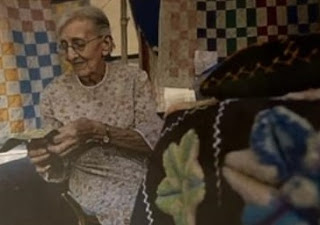
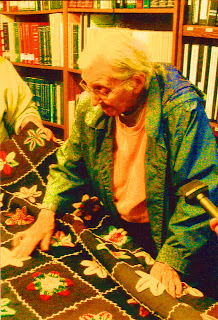
SS 2


Shirley was well aware of the irony of being a Jewish woman at what began as a celebration of Pennsylvania German culture.

As a business owner, she consciously downplayed her Jewish heritage because she was well aware of lingering anti-Semitism in the area. She recalled hearing anti-Semetic comments from unaware customers in her own shop, and she didn't want that to affect her income.

Her parents were English, though at least her father's people, as I recall, came from Eastern Europe. Her father may have served in the British Army, and Shirley said he also played the violin. Marty Riggleman, a long-time friend of Shirley's, said Shirley kept in touch with her father's people in England in later years and also took her daughter to visit them.

In Chicago, the family's original name was retained until Shirley's father decided he wasn't getting work because it singled him out as being Jewish. He changed it to Benson, and Shirley always signed her name Shirley B. Sacks. She was born in Chicago, but the family moved to New England to improve their economic prospects.

At some point her mother died, her father remarried, and, true to the stereotype of wicked step-mothers, things did not go well between Shirley and the new wife, who eventually had a daughter with Shirley's father but expected Shirley to take care of the baby. She left home as soon as she could but remained in New England and had a variety of jobs, including working in a five-and-dime store, as well as being a stenographer and secretary. She then met her future husband, Bernard [with the accent on the first syllable] who was serving in the Navy at the time.

He was from New Jersey, and that's where they married. He was a mechanical engineer, and later found work with a company in the Reading area. They bought a small farm with a limestone farmhouse in the foothills south of Fleetwood, and they had a daughter, Claire. Unfortunately Claire had childhood diabetes, which affected her eyesight and she eventually became legally blind. She was later accepted into a special school operated by what was then Kutztown State College. Claire also went into the Girl Scouts, which began a lifelong involvement for Shirley in the Scouts as well.

With Claire in school, Riggleman said Shirley had time on her hands and decided to open a craft store, the Crewel World, in Fleetwood as she had an interest in embroidery. And that is where fate intervened.

In her own words, and written for a publication she worked on for years but remained unfinished at the time of her death, Shirley recalled:

“My adventure with 'Star Embroidery' began with the kindness of a little old Pennsylvania Dutch lady whose name was Bertha Rauch. She lived across the street from my first shop in Fleetwood. This was the early 1970s. She knew I was interested in all kinds of needlework.

“One day she brought in a set of flower-shaped tin templates and told me that she had been taught how to do embroidery with them when she was very young. The history behind them is:

“When a wool blanket or men's suit wore out, seven- or eight-inch squares were cut from the good sections. Wool sweaters that were no longer usable were raveled out and the yarn used for the embroidery. The embroidery was done over the tin template on the squares. The squares were then stitched together to make a comforter or pillow or, with smaller pieces, for pin cushions. This technique goes back at least one-hundred years.

“Bertha very kindly shared her extra set of templates with me and I have been teaching 'Star Embroidery' ever since, from eight-year-olds to eighty-year-olds.

“My object in creating this booklet is to insure that this type of Pennsylvania German needlework is not lost.

“Whenever I pick up a needle to work this embroidery, I thank Bertha.”


SS 3


Riggleman, as Shirley's executor, has Shirley's notes for the booklet and plans to complete and print it, so the story and technique of her craft indeed will not be lost.

Shirley later moved The Crewel World to a Victorian-era brick house on Main Street in downtown Kutztown. She offered a wide variety of yarns, craft kits, and supplies. She also promoted and displayed the work of other area craftsmen, particularly the redware pottery of Gerald Yoder and the coverlets of weaver William Logan, with her shop, in effect, serving as a retail outlet for them.

She offered classes to a variety of age groups, both at her shop and at locations such as the Mennonite Heritage Center in Lancaster and many historic sites, craft shows and festivals across the region. For years, she went with Riggleman to do craft shows at Elfreth's Alley in Philadelphia.

She and I participated in many festivals, beginning in the mid-1980s, that included Landis Valley Museum in Lancaster and Bethlehem's Musikfest, and we often found ourselves sharing space at a number of historic sites. I particularly recall her at festivals held at the Alexander Schaeffer homestead in Schaefferstown. There, she was inevitably found at a table set up in the front yard teaching girls eager to try their hand at the embroidery projects she'd brought. I was always struck by how happy she was, with a big smile on her face.

The tools and supplies for her star embroidery did not take up much space in her small hatch-back, leaving room for a card table and chair. She could unload, set up, and be ready to start in minutes. I envied that simplicity while unloading large and cumbersome flax brakes and scutching wheels. And packing up and leaving, at the end of a long day, was just as easy. She was always glad to arrive, but she was always relieved to head back to her farm house as well.

Shirley was a serious crafter, and described her accomplishments in a draft for her projected book.

“I am a state and chapter juried member of the Pennsylvania Guild of Craftsmen since 1975. From 1970 until 2010, I had my own needlework business. As of January, 2014, I am listed as a craftsman in the directory of 'Early American Life' [magazine]. I also have my teacher certification in crewel embroidery from the Elsa Williams School of Needlework.”

At the time of her listing in EAL, she also had a small ad in the magazine offering free catalogs of her craft supplies and kits and got dozens of responses. She also wrote an article on star embroidery published in the magazine's Christmas issue of 2014.

Her husband and daughter were still living when I first met Shirley, but

Bernard eventually came down with dementia. Shirley cared for him as long as she could, but she eventually fell and was hospitalized, and Bernard was admitted to a nursing facility. There were issues with getting the Veteran's Administration to recognize his service since he did not serve overseas or in combat, so Shirley had to pay his nursing home bills while she fought with the VA to have him admitted to one of their facilities. That was finally accomplished, but he died soon after.

Meanwhile, Claire, who was an accomplished musician and studied the harp at the Julliard School in Manhattan, had become dependent on Shirley for support, and Shirley worried what would happen to Claire if she died first and her daughter would be left alone, but she didn't. It was Shirley who was left alone in her house, with her cat for company, while continuing a full schedule of craft shows and teaching. Eventually faced with declining sales, she moved her shop to a building further east on Main Street owned by Riggleman, and finally closed it altogether and operated out of her house. She wanted to turn a room in her house into a studio and classroom, but that never happened.

After I retired from doing craft shows and no longer saw Shirley regularly, I began visiting her occasionally and took her out to eat at the Kutztown Diner, near a small airport on the west side of town. She didn't eat much, but always had a take-out box for the leftovers and so another meal when she got home.

Shirley's physical decline was gradual but noticeable. At first, she walked unassisted to my car and into the diner; then she needed a cane, then a walker and, eventually, a wheelchair. In part, she suffered from osteoporosis, which increasingly bent her over and itself made walking difficult.

There came a time when she was unable to care for herself, and Riggleman found a place for her at an assisted living facility. Needless to say, Shirley was not happy and made her complaints loudly known and could not have been an easy resident to deal with. Still, she realized she needed help, even though that rankled her. She and Riggleman found another facility for her, this time in Kutztown, but she didn't like it either.

I visited her there, and even took her to the diner one last time, in a wheelchair. But the pandemic changed everything, of course, and I wasn't able to see her again. Even calling her became difficult. And then Riggleman called to say that Shirley had passed.

She was cremated, and Riggleman spread her ashes at her beloved farm. There were no close relatives, just some distant cousins on Bernard's side who didn't keep in touch.

She gave some samples and tools of her craft to the Hermitage where I live, which were arranged into a small exhibit in her honor. I like to recall Shirley's acid wit, her kindness, her smile, and her utter joy in teaching young girls the art of embroidery.

While Shirley was not religiously observant, I knew Jewish rituals were still important to her, and so after her death, also knowing there would be no one to say Kaddish for her, I found a prayer shawl in the Hermitage's Judaica collection, printed an English translation of the Hebrew Kaddish, and said it for her. True, there was not the minyan (a quorum of ten men) to make it official, nor am I Jewish, but I wanted to do something to remember her passing.

This short, simple prayer for the dead ends,

“May there be abundant peace from heaven, with life’s goodness for us and for all thy people, Israel. And let us say: Amen.

“May the One who brings peace to the universe bring peace to us and to all the people, Israel. And let us say: Amen.”

Dearest Shirley, rest in peace.


Shirley's Craft


In her 2013 interview with Reading Eagle reporter Jamie Klein, Shirley explained how she got involved with her craft.

“I demonstrate Pennsylvania German star embroidery. It's very much Berks County. It's a kind of embroidery that was done at least 150 years ago here in Berks County.
“It was taught to me by a lady who was born and brought up on a farm near New Tripoli, which is north of here. At that time, my shop was in Fleetwood, right across the street from where she lived. I was much involved in Girl Scouts at the time. My daughter was a Girl Scout, so they grabbed the moms, you know.
“She was in her seventies maybe at that time, and she was cleaning out her kitchen cupboards, and she found a whole set of patterns. She came trundling over [with] two sets of them. She thought that I would like to teach my Girl Scouts how to do this, and I did. That was at least 30 years ago, and I've been doing it ever since.”


SS 5


Today, Riggleman continues to teach the craft Shirley taught her to new generations, and hopes they might find new ways to adapt the style to different projects. She is also assembling Shirley's booklet for eventual publication.

In an interview, Marty explained the craft begins with a tin, six-pointed star [other designs are also possible, and even metal flashing can be used]. It is placed on strong fabric like wool. A hole is put in the center of the star so it can be attached to the fabric. The project can be placed in an embroidery hoop to secure it while working. Wool yarn is stitched twice around the perimeter of the star. Up to five colors of wool yarn are then sewn laterally across each petal. Next, the yarn is cut with scissors down the middle of each petal to the center. This releases the template which can be removed, leaving a raised yarn star.

After making a number of stars, they can be used as a form of applique to make a variety of objects, including lap robes, quilts, bed spreads, pillow covers, as decorative edging for table cloths, decorative rugs similar to hooked rugs, and, using a single small star, pin cushions or ornaments.


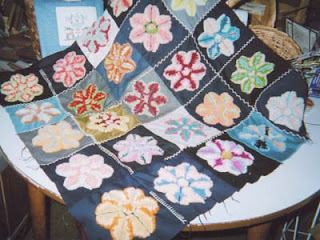
SS - 6


Marty continues to teach star embroidery at Wooden Bridge Drygoods outside Kuztown.

A few years ago Shirley gave the Hermitage examples of her craft, and several of the tin patterns she used, and we have them displayed in a tribute to her. We have also been able to find other examples of star embroidery that are included in the exhibit.


Illustrations


SS 1 - Shirley Benson Sacks at the Pennsylvania Folk Festival. Unknown year and date. Courtesy of Marti Riggleman.

SS 2 - Shirley at a workshop examining an embroidered star quilt. Unknown location and date. Part of the Shirley Sacks Exhibit at the Hermitage.

SS 3 - Antique tin star formerly owned by Shirley Sacks. Courtesy of Marti Riggleman.

SS 4 - Closeup of an embroidered Pennsylvania German star made by Shirley. Courtesy of Marti Riggleman.

SS 5 - Closeup of an antique Pennsylvania German star quilt from Shirley's collection. Courtesy of Marti Riggleman.

SS 6 - Another embroidered antique star quilt. Courtesy of Marti Riggleman.


The Hermitage will be open for tours from June through October by appointment by calling 570-492-4832, or via email at brojoh@yahoo.com. Our open house is Sunday, August 14, noon to 4 p.m. 


                                                                        SS 1


                                                                    SS 2


SS 3


SS 4


                                                                                SS 5


                                                                                SS 6